Two kinds of tow, two kinds of price
Thousand Oaks Tow Truck quotes every tow a vehicle owner asks us for as one total, before the truck leaves. That is the first thing to know about towing cost in Thousand Oaks: there are two kinds of tow, and California writes rules for only one. We do towing across Thousand Oaks and the Conejo Valley around the clock, and the number on the phone is the number on the invoice.
The tow you ask for is the one you arrange yourself: the car will not start at The Oaks, or you were rear-ended on the 101 at Moorpark Road and want it at a shop in Newbury Park. You call, we quote a total, a truck rolls.
The tow you did not ask for is the other kind: a lot owner has a car pulled off private property, or a deputy orders one off the street - 72 or more consecutive hours at the curb, registration expired more than six months, five or more unpaid parking citations, a driver arrested or unlicensed. The owner pays the tow and the storage.
Which one the law prices
Neither, in dollars: California has no statewide schedule. It sets rules for the tow you did not ask for - CVC 22658 for private property, CVC 22651.07 for the bill any tow yard hands you - and CHP rotation rates are approved per CHP Area and not published. Your own tow costs what you agree to before the truck moves.
What California law says a tow yard can charge
A private-property tow runs on CVC 22658. The lot needs signs at every entrance - at least 17 by 22 inches, letters an inch high, with the towing company's name and phone - and the tow company needs written authorization from the property owner or an agent present at the time. In a free public lot, CVC 22953 adds a one-hour grace period, with exceptions for hydrants, fire lanes, blocked entrances and disabled spaces; residential lots get no hour.
- Before it leaves the lot
- Get back before the car leaves the property and it has to be released, unconditionally; if it was already hooked up, the most the tow company can charge is half the regular tow charge.
- The benchmark
- A private-property charge is excessive if it exceeds the local law enforcement agency's tow-agreement rate or the CHP-approved rate for the jurisdiction, whichever is greater. Overcharging carries civil liability of four times the amount charged.
- One day's storage
- Released within 24 hours of reaching the yard, the storage charge is one day, regardless of the calendar date.
- The 10-mile rule
- The yard has to sit within a 10-mile radius of the property, absent prior written approval from the agency with primary jurisdiction.
- After hours
- The yard has to be open Monday to Friday, 8 a.m. to 5 p.m., and release vehicles after hours, with the gate fee capped at half the hourly tow rate.
- How you pay
- The yard has to take a valid bank credit card or cash, and say so on a posted notice.
Your rights at any tow yard
CVC 22651.07 covers every tow yard, whoever ordered the tow. Before taking your money the yard has to hand you an itemized invoice, and the Towing and Storage Fees and Access Notice posted in its office lists what you are owed: personal property at no charge during normal business hours, the car back within the first 72 hours without a lien fee, and payment by cash, check or credit card.
Policing in Thousand Oaks is contracted to the Ventura County Sheriff, and a tow company has to report a private-property tow to local law enforcement, so the Thousand Oaks Police station at 2101 E. Olsen Road, non-emergency (805) 494-8200, can tell you who has your car, whoever ordered the tow.
What moves the price of a tow you call for yourself
With no schedule to point at, your own tow is priced on what the job takes; this is what Thousand Oaks Tow Truck weighs.
Distance and route
The biggest single factor. A hook-up at the Civic Arts Plaza to a shop on Thousand Oaks Boulevard is a short run. Camarillo is about 13 miles, but the route is the Conejo Grade - 7 percent, no exits between Wendy Drive and Camarillo Springs Road. Malibu is about 18 miles by Kanan Road or the 23 down Decker Canyon; LAX, about 41 miles, is a transport.
Time of day
Where the truck is and what is on the board set the arrival window, which we tell you on the call. The hour is one input to the total, and the total comes first, so an after-hours emergency tow at 3 a.m. on the Grade is quoted the same way as one at noon.
Flatbed or wheel-lift
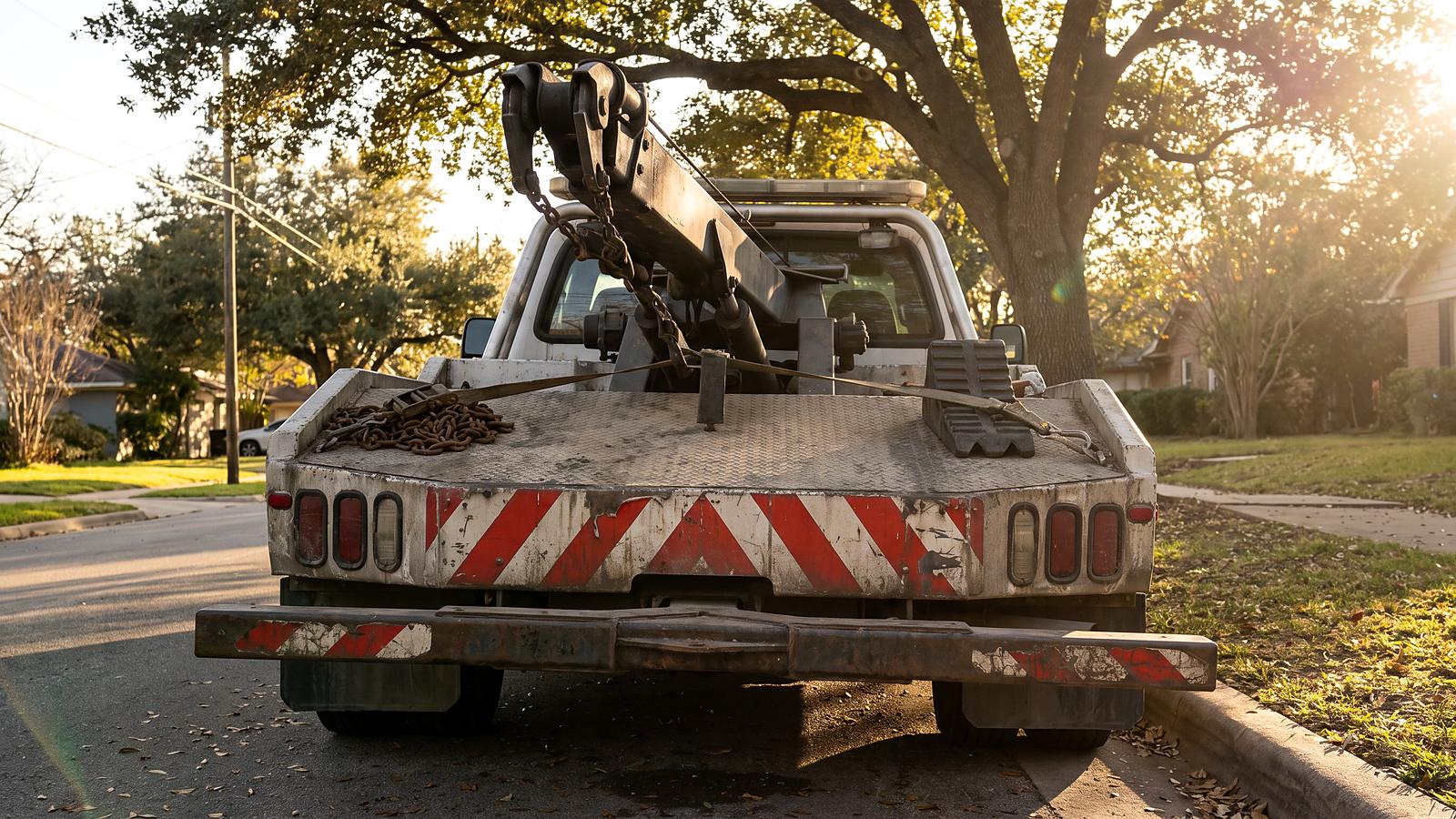
A wheel-lift raises two tires on a boom and yoke and lets the other two roll. AAA calls the flatbed ideal for all-wheel and four-wheel drive and for low-riding and exotic cars, and it is what moves a car that has been in a crash. Subaru's owner's manual says never to tow an AWD model with one axle on the ground; Tesla says a flatbed is the recommended method for a Model 3, with the tires never free to spin and dollies good for 35 miles at most. So flatbed towing and long-distance transport are quoted as a different truck doing different work.
Loading and recovery time
A car that rolls and steers in the open loads fast. No keys and a locked steering column, a flat with no spare - each takes longer, and that time is in the quote. Recovery is its own line: an SUV with two wheels off the shoulder of Potrero Road in dry brush comes back to solid ground on a winch line before it can be loaded. That is winch-out recovery work, with the tow on top.
- Where it goes, and whether it is open. A shop closed for the night means the car waits in its lot or is held until morning - a storage line.
- Tolls and handling. A toll on a long transport goes in the quote, and so does handling - a motorcycle chocked and strapped by the frame, boards under the ramps for a low car.
- When a roadside fix beats a tow. Not every call is a tow: jump starts, tire changes, fuel delivery and lockouts are smaller jobs, and heat is the number one cause of battery failure by AAA's count, so a car that only clicks in August may need a jump.
What a written quote should show and what to ask
A useful quote is a complete one; here is what to ask for.
The total, before dispatch
Ask for the total before the truck rolls - not an hourly rate, not a figure that begins with 'from'. A total means the company has asked about distance, vehicle and destination and will stand behind it at the curb. Ask who is coming, too: the name on the phone should be on the truck and the invoice, or a dispatch service sold your call to whoever was nearest.
Itemized
- Hook-up - the base charge for loading and moving the vehicle
- Distance - what the base covers and what each mile beyond it costs
- Recovery - any winching before the tow, as its own line
- Storage - the daily rate and release hours if the car will be held
- Anything else - a toll, waiting time, a second truck - named up front
What the bill from any tow yard must show
Whoever ordered the tow, CVC 22651.07 says the yard hands you an itemized invoice before taking payment. Check it for:
- Times - dispatch, arrival and completion
- Each charge on its own line - not one lump figure
- Storage days - one, if the car was out within 24 hours
- Gate fee - after-hours releases only, and no more than half the hourly tow rate
- Who directed the tow - the lot owner, agent or agency
- Payment - cash, check or credit card, never cash only; ask us how we take payment too
Coverage across Thousand Oaks and the neighboring towns
Distance is the one factor you can estimate yourself. From Thousand Oaks, Westlake Village is about 3 miles, Newbury Park and Agoura Hills about 5, Oak Park and Simi Valley about 10, Moorpark about 11, Camarillo and Calabasas about 13, Woodland Hills about 15, Malibu about 18, Oxnard about 21, Ventura about 29 and LAX about 41. Inside that circle a tow is a local job; a run over the Grade, down Kanan or into the San Fernando Valley is priced on the full distance the truck covers.
Frequently asked
How much does it cost to tow a car in California?
It depends on who ordered the tow; California sets no statewide dollar figure. Thousand Oaks Tow Truck quotes a tow you ask for as one total before dispatch, built from distance, the hour, flatbed or wheel-lift, and recovery time. A tow you did not ask for is measured against the Vehicle Code: a private-property charge is excessive if it exceeds the local law-enforcement rotation rate or the CHP-approved rate for the jurisdiction, and those rates are set per CHP Area and not published.
What is the minimum cost for a tow?
There is no legal minimum. The smallest job Thousand Oaks Tow Truck quotes is a short hook-and-go: a car that rolls and steers, going a few miles inside town on a wheel-lift, with no recovery. For a car towed off a private lot, the law caps the smallest charge of all: get back before it leaves and the tow company has to release it, for no more than half the regular tow charge if already hooked up.
How much is a tow lot fee per day in California?
California sets no statewide daily storage figure, only rules. After a private-property tow the charge is excessive if it exceeds the local law-enforcement rotation rate, a car out within 24 hours of reaching the yard is billed one day regardless of the calendar date, and an after-hours gate fee cannot exceed half the hourly tow rate. A police impound in Thousand Oaks adds an administrative release fee set by the City, on top of the tow yard's charges.
Does Thousand Oaks Tow Truck charge more at night or on weekends?
Thousand Oaks Tow Truck quotes the total before dispatch, whatever the hour or the day, and that number holds. The hour changes where the truck is and what is on the board, so it is one input to the total, not a surcharge added at the curb. For a tow you did not ask for, a yard has to release vehicles after normal business hours, and that gate fee is capped at half the hourly tow rate.
What is the cheapest way to get a tow?
Thousand Oaks Tow Truck will tell you when a jump start or a tire change is all you need. Beyond that, the cheapest tow is the shortest one with the least to do: a car that rolls and steers, going to a shop that is open, on one total quoted first. On the 101 through the Conejo Valley, the Ventura County Freeway Service Patrol tows you free to a CHP-approved drop location, but only weekdays 6:30 to 9:30 a.m. and 2 to 6 p.m., never to a shop or home; dial 5-1-1.