Winch-out and recovery in Thousand Oaks: what happens when you call
Thousand Oaks Tow Truck winches cars back onto the road around the clock: off the canyon shoulders on Kanan Road and the 23, out of trailhead dirt and winter mud, and out of the ditch after a crash. A recovery is a different job from a tow; the call starts by working out which one you have.
If anyone is hurt, or the car sits where traffic comes around a blind curve at it, call 911 first: officers can close a lane, we cannot. Then we ask four things.
- How far off the pavement it is. Two wheels on the shoulder is a short pull. A car far down a canyon slope may be beyond a light-duty truck's rating, and if so we say it on the phone.
- What it is sitting in. Dry brush, loose dirt, mud, a ditch or standing water each hold a car differently and change how the line is run.
- Whether it is on its wheels. A car on its side or roof is rolled back first, with the straps set so it lands on its tires.
- Where you are, exactly. The tunnel or mile marker on Kanan, the exit and direction on the 101, the trailhead, or the nearest cross street.
We quote the whole job and give you the arrival window on the call. If the car will need an emergency tow after the recovery because a wheel is folded or it will not start, that goes on the same quote before the truck rolls.
What a recovery costs in Thousand Oaks, and why it is quoted differently
A straight tow is hook, load, drive, unload, about the same every day. A recovery is not: nobody knows how a car will come out of the brush until the line is loaded. The cost page explains why recovery is quoted differently from a straight tow; the short version is four things.
- Time on scene. Walking the slope, setting an anchor, digging out a wheel and pulling in stages all take time, and time is the largest variable.
- Rigging. One winch line to a frame hook is the simplest pull; a car below the shoulder may need a snatch block and soft straps so nothing bends.
- A second truck. When there is no safe angle from the road, or a car must come up a bank without rolling, one truck holds while the other pulls.
- Whether a tow follows. Some cars drive away from a recovery; some ride a flatbed to a shop, a separate line on the same quote.
The Vehicle Code treats recovery as its own charge: under CVC 22651.07 a tow yard must hand over an itemized invoice of actual charges for towing, recovery or storage-related fees before it takes payment.
A tow the CHP orders after a crash goes through the CHP Rotation Tow Program, where rates are approved per CHP Area and not published, run portal to portal by the minute with no mileage charge, and must be shown to you on demand. California sets no statewide rate for a recovery you call for yourself, so we quote a total before the truck moves, not an open hourly rate.
What a winch-out involves: canyon shoulders, trailhead dirt, mud and crashes
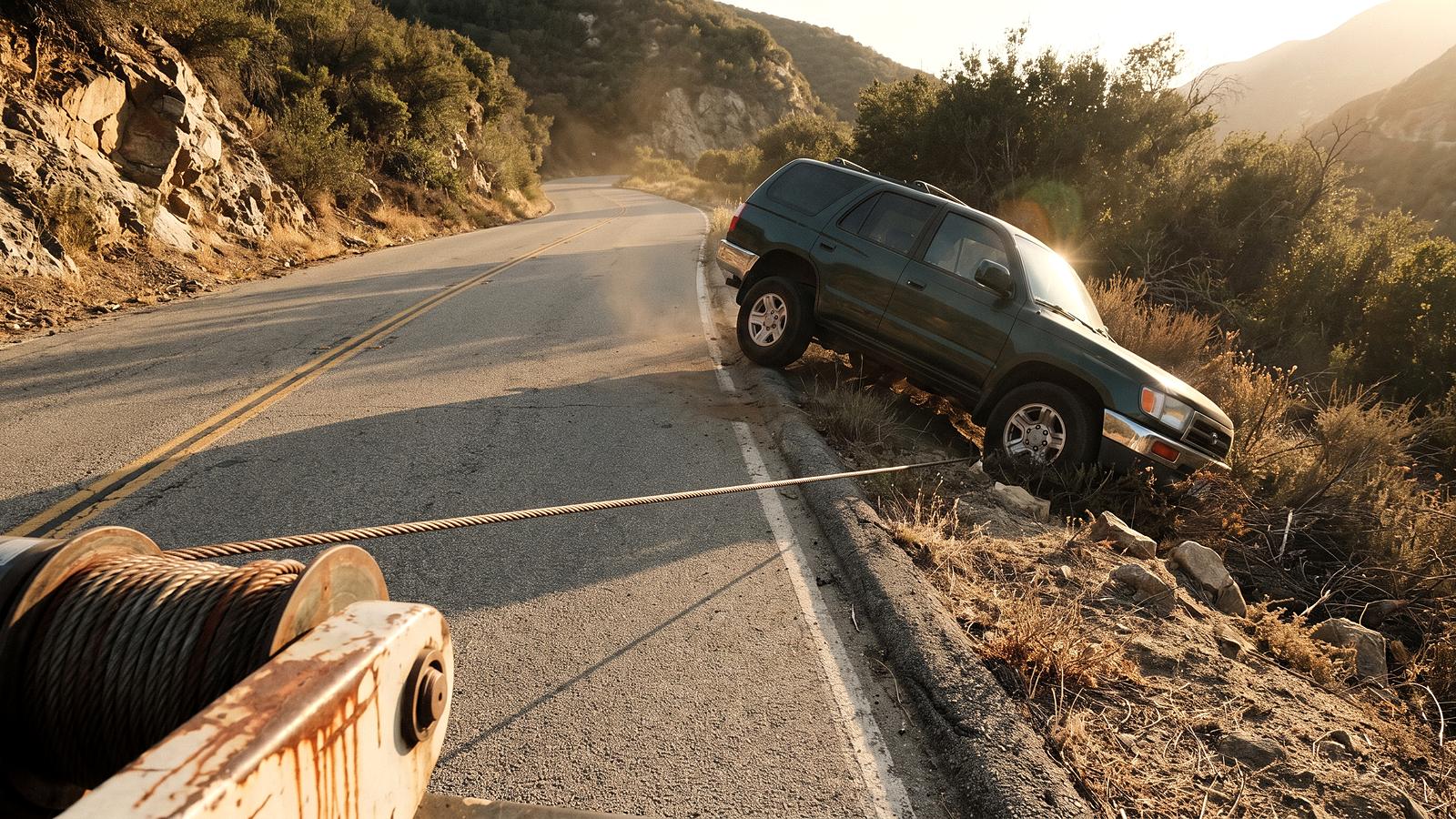
Canyon shoulders and drop-offs on Kanan and the 23
Kanan Road runs 19 miles from Westlake Boulevard south across the Santa Monica Mountains to the coast, through three tunnels and up to 1,800 feet. South of the 101, the 23 runs about two miles through Westlake as Westlake Boulevard and reaches PCH as Decker Canyon Road, a steep, winding drop where the rusted chassis of cars that went over the side can still be seen.
Two wheels off the edge is a pull we can plan: the truck anchors on the pavement above the car, the line runs to a tow point on the uphill side, and the car comes back at walking pace with the wheels turned to follow the line, never spinning. On a steep slope a second strap holds the downhill side so it cannot slide as it lifts.
Trailhead lots and dirt
The Conejo Open Space Conservation Agency's roughly 12,400 acres and 150-plus miles of trail draw cars that park on the edges: Wildwood Regional Park at 928 W. Avenida de los Arboles has 58 stalls, and the main Los Robles trailhead is at the south end of Moorpark Road. When the stalls are full, cars take whatever ground is left, and ground that was hard in August is soft in February.
Loose, dry dirt lets a spinning wheel dig down until the floor pan sits on the ground. The car comes out the way it can move: front wheels in a rut, we pull from the rear and lift the nose as it comes; high-centered, one end is lifted first so the underside is not dragged. Straps go to the tow points or the wheels, never an axle or a control arm.
Mud and ditches in winter rain
Thousand Oaks gets about 17 inches of rain a year, almost all of it in winter, and that is when the shoulder that held a car in October gives way and dirt turns to a mud that grips the tire. A ditch beside the road is the same problem at a worse angle.
A car in a ditch needs the line to lift as well as pull, so the pull is angled up onto the pavement, and sometimes a second truck is the only way to keep it from rolling as it comes over the lip.
After a crash
On the 101 and the 23 freeway, crashes are the CHP Moorpark Area's; on city streets they are Thousand Oaks Police, a contract with the Ventura County Sheriff. If an officer orders the tow, you have the right at the yard to your personal property at no charge during normal business hours and to a post-storage hearing, requested within 10 days.
The recovery runs in order: a car on its side or roof is rolled back onto its wheels, with the straps set so it lands on its tires, then dragged clear of the lane, and only then does the tow begin. A car that has hit something hard rarely rolls, so loading a damaged vehicle on a flatbed is done with the winch line, and dollies under a wheel that no longer turns.
A loaded winch line stores enough energy to hurt someone if a hook or strap lets go, and on a slope the car itself can slide. Stand uphill and off to the side, never below the car or in line with the cable, until the car is on pavement and the line is slack.
What not to do while you wait, and when a winch-out is the wrong call
Most of the damage we see on a recovery happened before the truck arrived, usually from someone trying to help.
- Do not spin the wheels. One gentle try in the car's own tracks is fine. If it does not move, stop: every spin digs the tire deeper and turns a strap job into a winch job.
- Do not let anyone yank it with a strap on a tow ball. A tow ball takes a trailer's steady load, not a shock load; when it shears it becomes a piece of steel on the end of a stretched strap.
- Do not wait in the car, or below it. On a canyon shoulder wait uphill, back from the edge. On the 101 or the 23, get out on the side away from traffic, behind the barrier if there is one; the Move Over law tells drivers to change lanes or slow for a stopped tow truck with amber lights on, and not everyone does.
Sometimes the winch is only half the answer. The Subaru owner's manual says never to tow an all-wheel-drive model with one axle on the ground, because the center differential will make it spin away; Tesla says the Model 3 rides a flatbed, with Tow Mode releasing the parking brake while it is winched up the deck, and never with the tires where they can spin.
Those cars come out on a straight, slow pull and go home on a flatbed, and so does anything with a folded wheel, bent steering or water above the floor.
Recovery across Thousand Oaks and the Conejo Valley
We run recoveries in every part of the city - Newbury Park and Dos Vientos, Westlake, North Ranch, Lang Ranch and Wildwood - plus unincorporated Lynn Ranch and Oak Park, and on the 101 from Lindero Canyon Road at exit 39 to Wendy Drive at exit 47C, then up the Conejo Grade with no exit until Camarillo Springs Road.
The Freeway Service Patrol covers that stretch of the 101 on weekdays, 6:30 to 9:30 a.m. and 2 to 6 p.m. only, never the 23 or Kanan, and never to a shop or your home. Off that road and outside those hours, a stuck car is a private recovery.
The trucks that run Thousand Oaks's towing and recovery service also cover the towns around it: Westlake Village about 3 miles away, Agoura Hills about 5, Oak Park and Simi Valley about 10, Moorpark about 11, Camarillo and Calabasas about 13, Woodland Hills about 15 and Malibu about 18 by road. A ditch in Agoura Hills is the same job as one on Lynn Road.
Frequently asked
What is a winch-out?
A winch-out is a recovery where Thousand Oaks Tow Truck lets the cable do the work rather than driving off with the car in tow. We anchor on firm ground, run the winch line to a tow point on the vehicle and pull it back to pavement slowly enough that nothing bends. A tow may or may not follow.
My SUV dropped two wheels off the shoulder on Kanan Road - can Thousand Oaks Tow Truck pull it back up without damage?
In most cases, yes. Thousand Oaks Tow Truck anchors on the pavement above the car and brings the SUV back at walking pace, with the line on a tow point and the wheels turned to follow it, so the pull loads the frame rather than the bumper. Tell us how far over the edge it is, because a car well down the slope may be more than a light-duty truck is rated for.
Do you recover vehicles after an accident?
Yes. Thousand Oaks Tow Truck handles accident recovery around the clock: rolling a car back onto its wheels, dragging it clear of the lane and winching it onto a flatbed. A tow the CHP orders goes through the CHP rotation at the Area's approved rate; if you call us yourself, we quote the recovery and the tow together before the truck leaves.
What is the 80/20 rule in towing?
The 80/20 rule is a rule of thumb for towing a trailer, not a law: keep the load under 80 percent of the vehicle's rated towing capacity, leaving 20 percent for hills, wind and braking. Thousand Oaks Tow Truck applies the same thinking to a recovery. A light-duty truck has a tow rating and a winch rating, and if a pull is beyond them we say so on the phone.
Can you pull a car out of flood water on a closed road?
Not while the road is closed. Thousand Oaks Tow Truck does not drive around a closure; the car waits until the road reopens and the water has dropped enough for the truck to reach it. Then we winch it to dry pavement and load it on a flatbed, because a car that has had water above the floor should not be towed with its wheels turning, or started, until a shop has checked it.