Need a tow? Flatbed towing in Thousand Oaks, CA
All-wheel drive, electric, lowered, classic or on two wheels: vehicles like these ride our flatbed with nothing touching the pavement, and Thousand Oaks Tow Truck sends it at any hour.
An EV that will not wake, a crossover with AWD: the call that sends our flatbed
An EV or hybrid that will not wake up in The Oaks lot, an all-wheel-drive crossover, a four-wheel-drive pickup, a lowered coupe, a classic, a motorcycle, a car a crash has left unable to roll or steer: none of these should travel with a tire on the road, so Thousand Oaks Tow Truck sends the flatbed. Which case is yours gets settled in the first minutes of the call.
Two identical crossovers parked side by side on Moorpark Road can need different tow trucks: one front-wheel drive and fine on a wheel-lift, the other all-wheel drive and not allowed to roll on either axle. That is why make, model and year are our first question and the drivetrain our second, and why the flatbed goes whenever the badge leaves any doubt.
Next come the pickup point and the destination. A car on the shoulder of the 101 or the 23 is a roadside emergency pickup, and the driver sets up with the passing traffic in mind; in a Lang Ranch garage or on a sloping Westlake driveway, the issue is finding room to lower the deck.
Nothing moves until you have heard the arrival window and a single total. The hour does not matter either: our Thousand Oaks tow trucks run all night, so a flatbed call in the middle of the night gets the same treatment as one in the middle of the day.
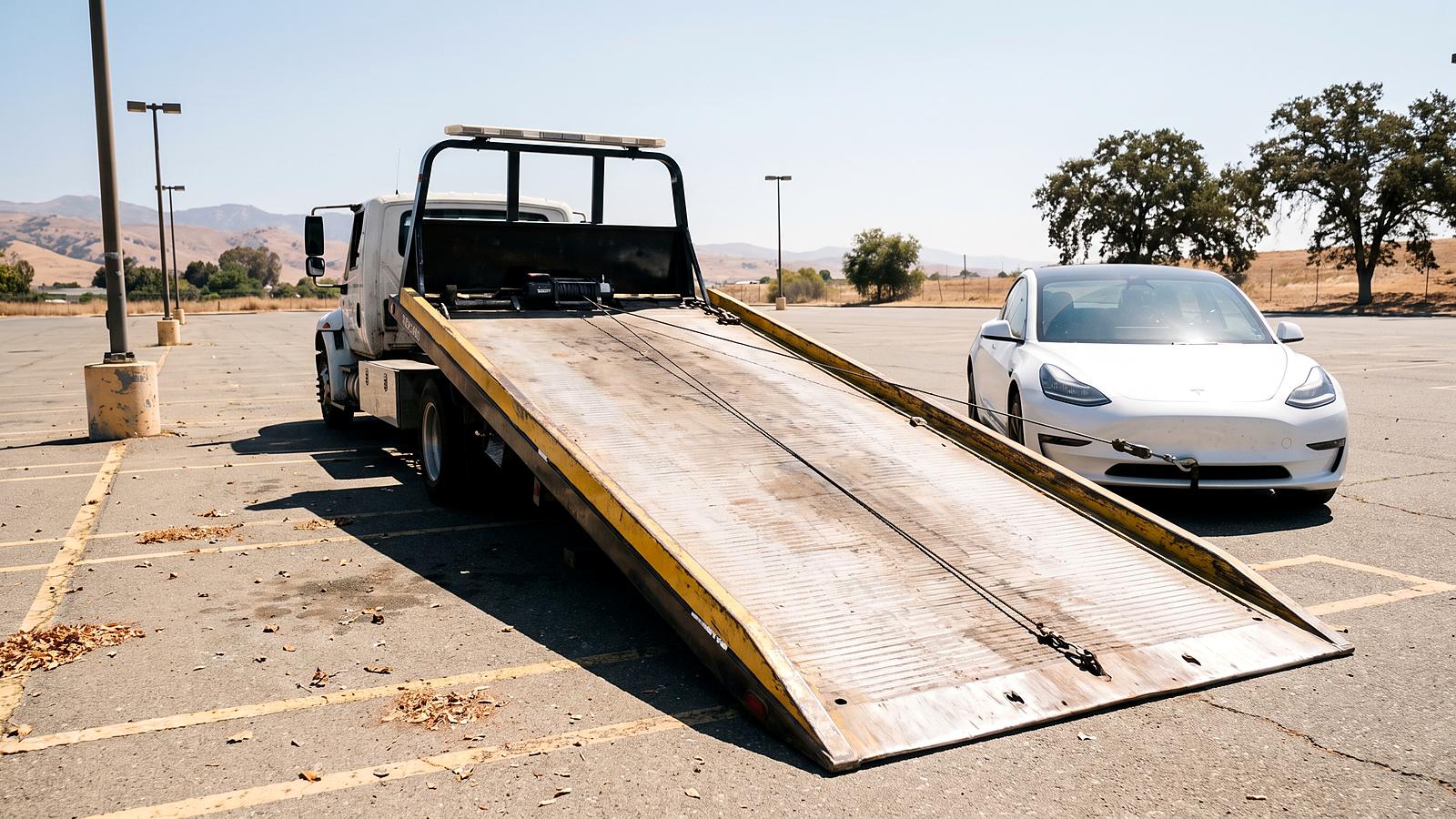
Loading always runs in the same order, and photos come first, so the car's condition is on record before anyone touches it. The tow truck then backs in until the tilted deck lines up with the car, the winch cable goes to the tow eye or to a pair of wheel straps, and the car creeps up. With the deck level again, each of the four wheels gets its own strap.
Newbury Park to Malibu on the bed: what a flatbed quote is made of
Ordering a flatbed for your own car makes it a consensual tow, and consensual tows fall outside every price reference California has. The CHP's rotation rates, which each Area approves and keeps confidential, cover officer-ordered tows; the Vehicle Code 22658 benchmark covers private-property tows; and no statewide cap exists at all. That leaves the figure to us, and it reaches you by phone, a single total stated before dispatch.
Start with the map, since miles matter more than anything else. A Newbury Park car headed for a shop on Thousand Oaks Boulevard is local work. Camarillo, roughly 13 miles off, puts the Conejo Grade on both legs; Simi Valley, roughly 10, runs out the 23 and the 118; Malibu, roughly 18, means Kanan Road and its three tunnels or Decker Canyon. Those runs are priced per mile. Anything farther is priced on the miles plus the time the tow truck spends away from the valley.
The destination takes time of its own, and you pay for the tow truck's time. Dropping a car into one assigned bay at a dealership, or at a canyon-road house without a level patch for the deck, takes longer, and that time is written into the quote you approve.
Then there is the loading itself. Locked steering, a stuck parking pawl or a dead 12-volt system means dollies under the wheels that will not turn, which takes longer and is added on the call; a car free to roll and turn its wheels comes up the deck in a single pull. And a car that has left a canyon road for the brush needs a winch-out to reach solid ground before any loading, priced as a separate job.
For the full breakdown, see how miles and loading set a flatbed price, which also sets out the rules for tows ordered by police or a lot owner: the half-fee rule, one day of storage for a car out within 24 hours, the 10-mile yard limit and the law-enforcement-rate benchmark.
A Subaru, a Tesla, a lowered coupe, a motorcycle: why each travels on the deck
Driven axles tied together
Picture a car hanging from a wheel-lift: two tires in the air, two turning on the pavement. On an all-wheel-drive car a center differential connects the two axles, and on a four-wheel-drive one a transfer case does, so turning one pair of wheels while the other sits motionless forces the road to drive the transmission. AAA's comparison warns that dragging a car's front wheels can damage its transmission. Nissan's bulletin tells owners of its 4WD and AWD automatics never to flat tow them and never to put them on a tow dolly, which it says harms drivetrain parts. Subaru's owner's manual rules out any tow of its AWD models with just one end raised, since the center differential could cause the vehicle to spin away.
Battery-electric and hybrid cars
For the Model 3, Tesla's manual sets the flatbed as the preferred way to move the car and prohibits transporting it with the tires able to spin. It allows a wheel-lift with dollies only as a fallback, and for 35 miles at most. Tow Mode holds the parking brake off while the car is winched up the deck, the tires turning below 5 miles per hour over a distance shorter than 30 feet.
Low noses and long overhangs
A lowered hatchback, or a vintage sedan whose bodywork reaches far past the front wheels, has no room under its nose for a wheel-lift's yoke. AAA agrees on the answer: it rates the flatbed the right carrier for exotic and low-riding cars, and the wheel-lift a poor one for them and for motorcycles. The rest is technique. We look for the flattest ground available, block the ramp at the lip of a steep driveway, pull slowly, and hold the car with straps across its tires rather than hooks on its frame.
Two wheels on the deck
A bike is rolled up the deck until its front wheel seats in the wheel chock, and it travels standing on its tires in that chock rather than on a stand. Straps attach to the frame, the fork and the swingarm, never to brake components or rotors, and each hook finishes on a D-ring. U-Haul's loading guide sets the tension: snug, but not so tight that the suspension bottoms out.
A front-drive sedan across town, a Tesla to LAX: choosing between wheel-lift and bed
Take a front-wheel-drive sedan going from Newbury Park to a shop on Thousand Oaks Boulevard. Raised by its driving wheels with the rear tires rolling, it rides the wheel-lift safely and the job goes quickly; when a tow like that does not need the deck, we say so.
Dollies earn their place in one situation: when a front-drive car's nose is smashed, it has to be raised from behind, and dollies under its front tires keep every axle still. On an all-wheel-drive automatic we will not use them at all, because Nissan's bulletin rules them out and the carmaker has the final word.
Occasionally the smart move is no tow. When the heat has finished off a 12-volt battery, when a flat comes with a sound spare, or when the key is locked inside, the cheaper answer is a jump, a tire change or a lockout visit, not a flatbed you never needed.
Weekday mornings from 6:30 to 9:30 and afternoons from 2 to 6, the Freeway Service Patrol works the 10.5 miles of the 101 between the county line and Camarillo Springs Road and moves a disabled car free to a CHP-approved drop location. It stays off the road at night, on weekends and on holidays, never works the 23 or surface streets, never tows to a shop or a home, and never takes a motorcycle. Everything after the drop location is a private tow.
Long runs out of the valley
Every long run goes on the flatbed, since a car riding the deck puts no miles on its own drivetrain. The price runs by the mile, and we give you an expected delivery time as well. Dealers and body shops usually take cars at a service entrance, so the shop hears from us before we arrive, and the car is unloaded at the spot the shop names.
Leave the car in park, parking brake on, until the driver asks for neutral - on any slope, neutral lets the car roll. Tesla owners should switch on Tow Mode only when the driver says so, since it releases the parking brake. House keys and the garage opener come out of the car before it departs.
From exit 40 to the foot of the Grade: flatbed pickups in and around Thousand Oaks
Our flatbed covers every corner of the city - Newbury Park and Dos Vientos, Rancho Conejo, Westlake, North Ranch, Lang Ranch, Wildwood and unincorporated Lynn Ranch - and each 101 exit: 40 for Westlake Boulevard and the 23 South, 41 Hampshire Road, 42 Rancho Road, 43 for the 23 North, 44 Moorpark Road, 45 Lynn Road, 46 Ventu Park Road, and 47 for Rancho Conejo Boulevard, Borchard Road and Wendy Drive, the final exit ahead of the Grade.
Outside the city the distances run roughly 3 miles to Westlake Village, 5 to Newbury Park and Agoura Hills, 10 to Oak Park and Simi Valley, 11 to Moorpark, 13 to Camarillo and Calabasas, 15 to Woodland Hills, 18 to Malibu, 21 to Oxnard, 29 to Ventura and 41 to LAX, and the flatbed covers them all.
Two places send us the flatbed again and again: The Oaks mall at 350 West Hillcrest Drive, where an electric car that refuses to wake has to go on the deck, and the trailhead lots at Wildwood Regional Park and at Los Robles, south end of Moorpark Road, where a lowered car that scraped its way in leaves riding the bed.
Frequently asked questions
Is a wheel-lift safe for my all-wheel-drive SUV?
A wheel-lift is not safe for an all-wheel-drive SUV, and three sources explain why. An all-wheel-drive or four-wheel-drive SUV has its axles coupled, so letting one pair roll turns the transmission from the pavement; AAA cautions that towing with the front wheels dragging can hurt the transmission, Nissan prohibits flat towing or dollying its 4WD and AWD automatics, and Subaru's manual bans towing an AWD model with just one pair of wheels lifted. Thousand Oaks Tow Truck therefore carries these vehicles on the flatbed, where no part of the drivetrain moves.
How do you move a Tesla that will not start?
A Tesla that will not start goes on the flatbed, winched up so that no tire touches the road. Tesla's Model 3 manual prefers that method, forbids moving the car in any way that lets the tires spin, and accepts a wheel-lift with dollies only as a fallback, for 35 miles at most. Thousand Oaks Tow Truck has Tow Mode switched on first so the parking brake stays released while the winch works. Tell us on the call whether the touchscreen still lights up, since a dead 12-volt system changes how the car is loaded.
How does a motorcycle ride on your tow truck?
Motorcycles ride our flatbed and nothing else. AAA judges a wheel-lift unsuitable for motorcycles, so Thousand Oaks Tow Truck walks the bike up the deck until its front tire sits in the chock, then runs straps from the frame, fork and swingarm down to D-rings, tight enough to hold it and loose enough that the suspension never bottoms. On the 101 the Freeway Service Patrol will not take a motorcycle at all, which leaves a stranded bike to a private tow.
Do you run a flatbed beyond the Conejo Valley?
Our flatbed runs well beyond the Conejo Valley. The Conejo Grade takes it to Camarillo, Oxnard and Ventura; the 23 takes it to Moorpark and Simi Valley; Kanan Road takes it to Malibu; and the 101 carries it into the San Fernando Valley and on to LAX - on top of everyday runs inside Thousand Oaks and its neighbors. Every one of those trips is priced chiefly on its miles, and Thousand Oaks Tow Truck states the total by phone before the tow truck sets off.
My car is lowered. Will the ramp scrape it?
Scraping happens at the ramp angle, so that is what we manage. Thousand Oaks Tow Truck picks the most level ground on hand, lowers the deck to its gentlest slope and props the ramp at the lip of a steep driveway, then winches slowly while the driver keeps watch on the nose. Lowered cars, classics and anything with little ground clearance never go on a wheel-lift, which AAA says does not suit low riders; straps across the tires hold them, never hooks on the frame.
Sending the flatbed: what we need to know about your car
Share these on the phone and the price and the dispatch happen in one conversation.
- Year and make: plus the model, noting AWD, electric power, a lowered body or two wheels
- Its condition: does it roll, does it steer, does it power on
- Pickup point: the parking row, the nearest cross street, or the freeway with your direction and exit number
- Where it ends up: a repair shop, a dealer, a driveway or a city farther off